
Osteoporosis Inspiration
- Celeste
- Dec 2, 2025
- 7 min read
Updated: Dec 3, 2025
Why are we osteoporotic?
How to live freely with osteoporosis and osteopenia.
My mother had osteoporosis and osteoarthritis.

To begin, a few facts.
Osteopenia is the precursor to osteoporosis. A T-score between -1 and -2.5 indicates osteopenia, a condition of low bone density. The T-score compares your bone density to that of a healthy young adult of the same gender; a score of -1.0 or higher is considered normal, while a score of -2.5 or lower indicates osteoporosis.
At The Yoga House, I conduct a workshop focused on Osteoporosis and Osteopenia. The primary objectives of the workshop are to offer an in-depth understanding of physical activities you can undertake. Participants leave with a clear grasp of movement techniques, frequency, and key aspects to prioritize in exercise, movement, and nutrition. If this workshop resonates with you, here is the link: https://www.theyogahouse.ca/service-page/osteoporosis-osteopenia-workshop?referral=service_list_widget
*
If I had you here, in front of me, and you said, "Celeste, just tell me what I need to do to be safely active with osteopenia or osteoporosis?" Which would be so delightful, as I have created the Osteoprosis Workshop to address this very question! Then I would answer like this:
My mother had osteoporosis and it truly led to her physically limited life as she moved into her later years. She broke 3 bones in the last 2 years of her life and I feel this lead to her passing in June of this year. (Thus the picture of my very fun Mom above to honour her spirit!)
I have osteoporosis, osteoarthritis and degeneration of my spine. I am active seven days a week. I started weight training when I was 13 years old daily and have trained with weights consistently to this day. My Dexa scan shows I have a high muscle percentage and this has contributed to strong connective tissue (ligaments, tendons) and this tissue attaches to bone, improving the "spongy" quality of the inner bone. My Mom's generation did not know about weight training, and when I introduced it to my Mom, she was very willing. It was later in her life and research shows that the bone density bank is pretty set by 35 - 40 years in a woman's life. I could see that although she dabbled with resistance training, the damage to her bone health made it difficult to improve. Not to mention to feel like she was progressing, which gave her little incentive. Yet, for all of us, any form of weight training or resistance training, will improve your overall strength and thereby ability to have a strong physical foundation for all that you do. I recognize that my life as an avid weight trainer may cause me to be less objective, yet I will state here that I have seen with every client, student or patient as a Kinesiologist, that working with weights or using the body as resistance, has improved the overall quality of that individuals life!
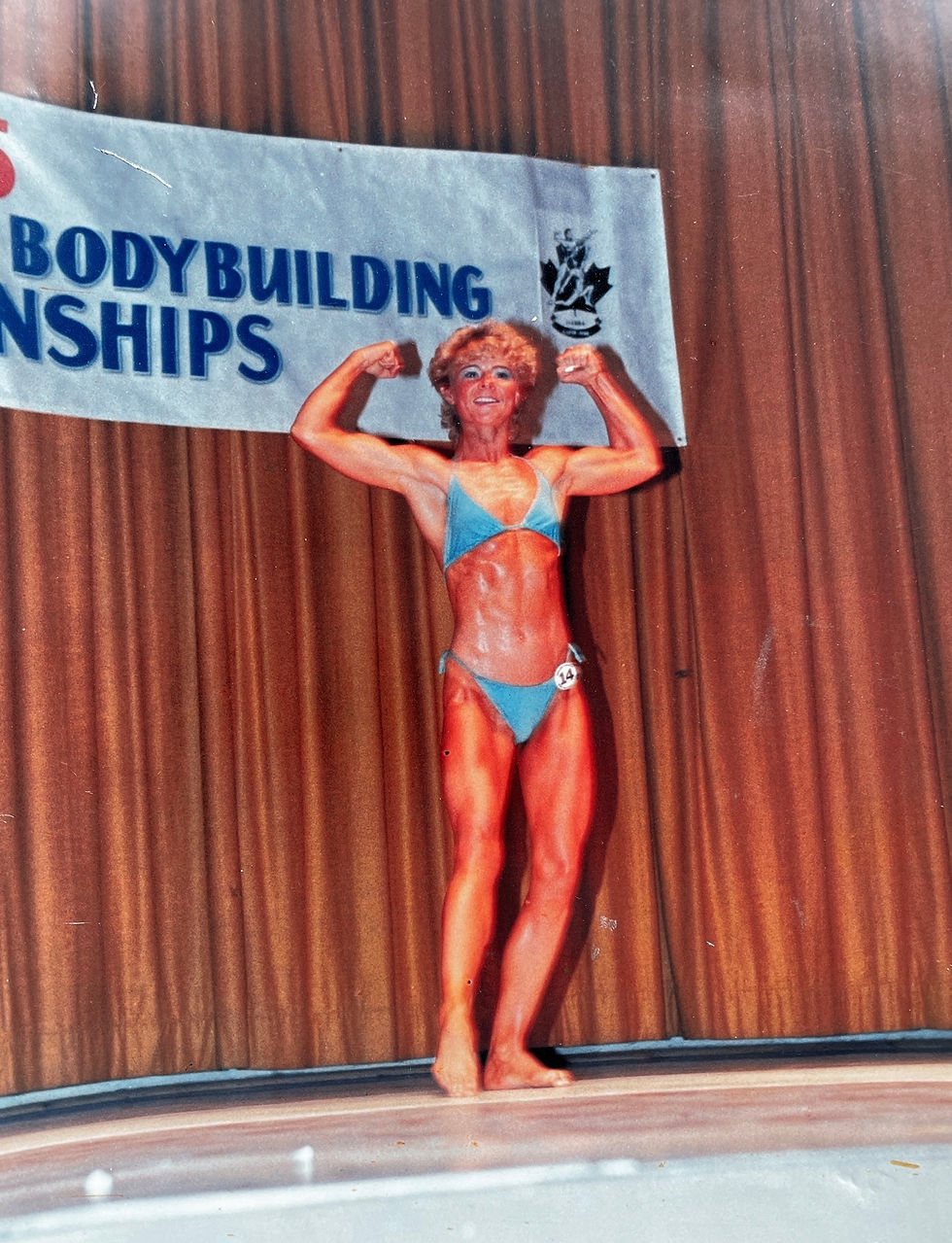
Now, today, in this short entry, I would like to reveal how to live actively with confidence. If we adopt a mindset to recognize we have a diagnosis of osteoporosis, yet are not defined by it, we will feel more freedom to sense what our bodies can do.
Here is a quick summary of how I have used my mind to stay active:
I forget my diagnosis, and see and feel what my body can do each moment.
I trust my body and breathing to guide me by understanding "healthy" pain. Healthy pain is the discomfort we feel when we push ourselves and it feels like "we can't" do that much, yet we know it is uncomfortable, which means we don't like it. We remember that "not liking" means we are out of the comfort zone of what (we believe) our body is capable of, and if we keep going, it can lead to adaptation. This is referred to as The Overload Principle in kinesiology. Performing/doing/stretching beyond what you are used to, develops the tissue and muscle to get used to it. It's so simple that it's embarrassing! If we can remember that our mind does not like discomfort, then we can use our mind to push through the threshold into a greater strength and range of motion. (Relevant disclaimer: always listen to your body and stop when any movement hurts in the strong, stabbing, catches your breath kind of manner. Also, if a joint or muscle aches after a movement, note to reduce the intensity or range of motion for that area next time.)
I know that genetics are proven to be the most accurate factor contributing to osteoporosis (that's my Kinesiolgist' "hat" speaking!) and I let go of the idea that I inherited this from my Mom. Maybe, maybe not.
At 62, my reduced estrogen, which could be 40% lower after menopause, has definitely affected my bone's density. Estrogen is a "building" hormone. Knowing that this stage of my hormonal-life could truly weaken my bones and muscles, I feel that much more inspired to work my body fully to keep all the parts feeling strong.
If I feel tired, I still do my exercise/yoga. I always, and I do mean always, feel better afterwards.
*
And now back to our previously scheduled entry with all the facts about the bones I'd like you to know, so you can understand what happens to your bones as time goes by (or what Silly People call aging!)
Approach to bone health
Our bones are made of two major components: osteocalcin and minerals. Osteocalcin is a spongy, flexible, connective tissue matrix into which the minerals are embedded. This allows our bones to flex and give under pressure. Healthy osteocalcin can protect the bones against fracturing.
What does osteocalcin do for bones?
Importantly, osteocalcin is secreted solely by osteoblasts but only has minor effects on bone mineralization and density. Instead, it has been reported to control several physiological processes in an endocrine manner, such as glucose homeostasis and exercise capacity, brain development and cognition.
Although osteocalcin integrity is just as important as the amount of minerals packed in the bones, we have no way of measuring osteocalcin health. Current tests track only bone mineral density. So almost all our research focuses on bone mineral content. Very little research addresses osteocalcin because we have no testing method for this important part of the bone. Keep in mind that while much of our discussion about bone integrity will center on BMD bone mineral density, the spongy connective tissue matrix is equally important.
It is important to develop the elasticity of the joints and muscles (flexibility and range of motion) and what I like to call “the ability to bounce.” Include agility and power exercises in your routine. You can do speedy movements like changing direction of your limbs rapidly—try a crazy dance of your legs in the air when lying on your back. Jumping up and down on the spot, and then on one leg, or shaking out your limbs are helpful too.
Do we have "different" bones?
We have two types of bone, trabecular and cortical. Trabecular bone is the inner part that includes the bone marrow. The architecture, or structure, of trabecular bone prevents compression under pressure. Lack of physical exercise, low estrogen levels, and steroid use contribute to trabecular bone loss.
Cortical bone is a hard, circular, protective outer layer that protects the bone from trauma. This bone layer turns over at a much slower rate than trabecular bone, which is much more metabolically active. Low calcium and vitamin D levels most significantly impact the cortical bone.
The extremities (leg and arm bones) are 90% cortical bone in contrast, the heel is made exclusively of trabecular bone. The hip bones are 50% trabecular and 50% cortical, while the spine is 90% trabecular and 10% cortical. Ideally, a BMD scan tests hip and spine to accurately assess both trabecular and cortical bone health.
Bone and a woman’s lifecycle
From the time we are born, we build more bone than we lose, finally reaching peak bone mineral density between 35 and 40 years old. After age 40, we begin to break down more bone than we rebuild, losing about .52 - 1.0% bone mass per year. For 8 to 10 years after menopause, bone loss, increases by 2 to 5% per year. The rate of loss slows down again after age 65.
For bone health, prevention is truly more effective than trying to cure it. The best time to prevent osteoporosis is during the formative years, before age 35. The higher our bone mineral density in our mid to late 30s, the smaller risk of bone fractures later in life. The good news is that you can still prevent and sometimes even reverse bone loss even after menopause. (The average age of menopause is 52 years.)
One yoga student increased her bone density so much, she could move out of the “osteoporotic” status. (This is a yoga student) Yet, because she had incurred a wrist fracture (any fracture) her Dr. kept her in the osteoporotic diagnosis. So please note: you can increase bone density.
How responsive your bones will be, and how aggressive you must be in order to impact bone health, depends on your particular body, and your overall state of health. You can monitor your progress by repeating the BMD scan at regular intervals.
It's worth emphasizing (repeating) that the most effective form of exercise for bone health is weight training or any resistance training. Doing a body squat or lunge is resistance training. HIIT (high intensity interval training) is also extremely effective for increasing bone density. To help you do some HIIT training at home, I made a HIIT training video for one of my clients and we put it on my YouTube channel. Here is the link: https://www.youtube.com/watch?v=gvvDKHSHHVs
Which yoga poses do I need to avoid?
If you need help understanding specifically which poses in yoga are safe and which to avoid or modify due to scoliosis, I recommend referring to this link from Osteoporosis.ca https://osteoporosis.ca/oc-blog/yoga-and-osteoporosis-suggestions-for-safe-and-appropriate-practice-part-2/


Comments